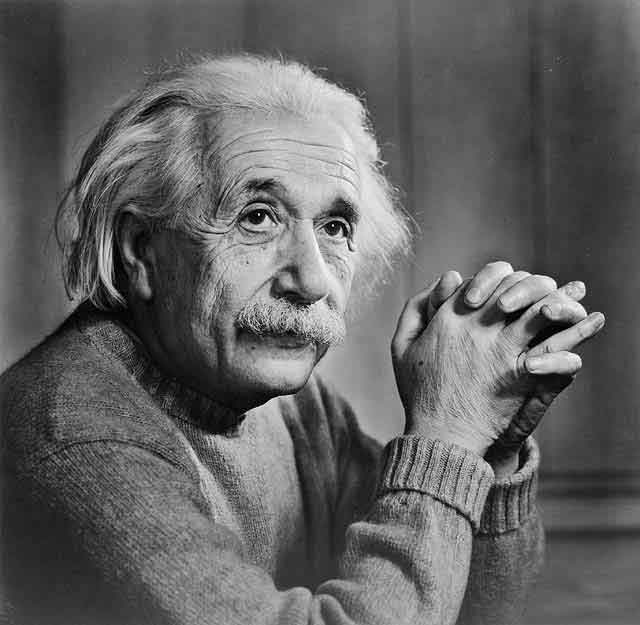
Albert Einstein was born at Ulm,
in Württemberg, Germany, on
March 14, 1879. Six weeks later
the family moved to Munich,
where he later on began his
schooling at the Luitpold
Gymnasium. Later, they moved to
Italy and Albert continued his
education at Aarau, Switzerland
and in 1896 he entered the
Swiss Federal Polytechnic School
in Zurich to be trained as a
teacher in physics and
mathematics. In 1901, the year
he gained his diploma, he
acquired Swiss citizenship and,
as he was unable to find a
teaching post, he accepted a
position as technical assistant in
the Swiss Patent Office. In 1905
he obtained his doctor's degree.
During his stay at the Patent
Office, and in his spare time, he
produced much of his
remarkable work and in 1908 he
was appointed Privatdozent in
Berne. In 1909 he became
Professor Extraordinary at Zurich,
in 1911 Professor of Theoretical
Physics at Prague, returning to
Zurich in the following year to fill
a similar post. In 1914 he was
appointed Director of the Kaiser
Wilhelm Physical Institute and
Professor in the University of
Berlin. He became a German
citizen in 1914 and remained in
Berlin until 1933 when he
renounced his citizenship for
political reasons and emigrated
to America to take the position of
Professor of Theoretical Physics
at Princeton *. He became a
United States citizen in 1940 and
retired from his post in 1945.
After World War II, Einstein was a
leading figure in the World
Government Movement, he was
offered the Presidency of the
State of Israel, which he declined,
and he collaborated with Dr.
Chaim Weizmann in establishing
the Hebrew University of
Jerusalem.
Einstein always appeared to have
a clear view of the problems of
physics and the determination to
solve them. He had a strategy of
his own and was able to visualize
the main stages on the way to
his goal. He regarded his major
achievements as mere stepping-
stones for the next advance.
At the start of his scientific work,
Einstein realized the
inadequacies of Newtonian
mechanics and his special theory
of relativity stemmed from an
attempt to reconcile the laws of
mechanics with the laws of the
electromagnetic field. He dealt
with classical problems of
statistical mechanics and
problems in which they were
merged with quantum theory:
this led to an explanation of the
Brownian movement of
molecules. He investigated the
thermal properties of light with a
low radiation density and his
observations laid the foundation
of the photon theory of light.
In his early days in Berlin,
Einstein postulated that the
correct interpretation of the
special theory of relativity must
also furnish a theory of
gravitation and in 1916 he
published his paper on the
general theory of relativity.
During this time he also
contributed to the problems of
the theory of radiation and
statistical mechanics.
In the 1920's, Einstein embarked
on the construction of unified
field theories, although he
continued to work on the
probabilistic interpretation of
quantum theory, and he
persevered with this work in
America. He contributed to
statistical mechanics by his
development of the quantum
theory of a monatomic gas and
he has also accomplished
valuable work in connection with
atomic transition probabilities
and relativistic cosmology.
After his retirement he continued
to work towards the unification
of the basic concepts of physics,
taking the opposite approach,
geometrisation, to the majority
of physicists.
Einstein's researches are, of
course, well chronicled and his
more important works include
Special Theory of Relativity
(1905), Relativity (English
translations, 1920 and 1950),
General Theory of Relativity
(1916), Investigations on Theory
of Brownian Movement (1926),
and The Evolution of Physics
(1938). Among his non-scientific
works, About Zionism (1930),
Why War? (1933), My Philosophy
(1934), and Out of My Later Years
(1950) are perhaps the most
important.
Albert Einstein received honorary
doctorate degrees in science,
medicine and philosophy from
many European and American
universities. During the 1920's
he lectured in Europe, America
and the Far East and he was
awarded Fellowships or
Memberships of all the leading
scientific academies throughout
the world. He gained numerous
awards in recognition of his
work, including the Copley Medal
of the Royal Society of London in
1925, and the Franklin Medal of
the Franklin Institute in 1935.
Einstein's gifts inevitably resulted
in his dwelling much in
intellectual solitude and, for
relaxation, music played an
important part in his life. He
married Mileva Maric in 1903 and
they had a daughter and two
sons; their marriage was
dissolved in 1919 and in the
same year he married his cousin,
Elsa Löwenthal, who died in
1936. He died on April 18, 1955
at Princeton, New Jersey.
From Nobel Lectures, Physics
1901-1921, Elsevier Publishing
Company, Amsterdam, 1967
This autobiography/biography
was written at the time of the
award and first published in the
book series Les Prix Nobel. It was
later edited and republished in
Nobel Lectures. To cite this
document, always state the
source as shown above.
* Albert Einstein was formally
associated with the Institute for
Advanced Study located in
Princeton, New Jersey.